In partnership with

Every portrait I generated looked wrong until I added two characters to my prompt.
Reading this in Promotions? Move it to Primary so you never miss an issue.
|
|
|
One Ingredient · Issue 01
The one word that fixed
all my portraits.
It is not a style. It is not a mood. It is a number. And it changes everything about how AI renders a human face.
|
|
The era of manual marketing ends this May!
Manual marketing had a good run.
But the teams winning right now aren't briefing, approving, and repeating. They're directing AI agents that execute the whole strategy for them.
The Agentic Marketing Summit (May 4–8) is a free, five-day event that shows you exactly how it works in practice. Not theory. Not a PDF checklist. Step-by-step insight to help you become an expert in AI marketing agents.
Hosted by 3x Inc 5000 founder Manick Bhan alongside the sharpest minds in the marketing world today.
The era of doing it yourself is over!
|
I spent weeks writing longer and longer prompts trying to get portraits that looked professional. I described lighting in detail. I specified skin texture. I listed three negative prompts. I wrote paragraphs. The outputs were fine. They looked like AI portraits. Clean, centered, generic. Nothing you would mistake for a real photograph.
Then I added two characters to the end of a prompt. Just two. The number 85 and the letters mm. And the portrait that came back looked like it was taken by a professional photographer in a studio.
That is not an exaggeration. The 85mm lens is the single most powerful modifier I have found in a year of AI image prompting. Here is why it works and how to use it.
|
|
Why 85mm
What a real 85mm lens does to a face.
|
|
In real photography, every lens renders faces differently. A wide-angle lens like a 24mm makes noses look bigger and ears look smaller because of how it stretches perspective. A 50mm lens is more natural but still slightly unflattering at close range. The 85mm lens does something specific that photographers have relied on for decades. It compresses perspective just enough to flatten facial features in a way that is subtly, universally flattering.
Noses appear slightly smaller relative to the rest of the face. Cheekbones look more defined. The spatial relationship between eyes, nose, and mouth looks balanced and pleasing. None of this is dramatic. You would never look at an 85mm portrait and say "that nose looks smaller." You would just think the person looks good. That is what makes it so effective. It flatters without being obvious about it.
The other thing 85mm does is separate the subject from the background. At wide apertures like f/1.4 or f/1.8, the background dissolves into soft, creamy circles of light called bokeh. The subject is razor-sharp. The background is an abstract wash of color. That separation is what makes professional headshots look professional. The subject exists in their own space, isolated from the clutter behind them.
Nearly every professional headshot, beauty campaign, and fashion editorial in existence was shot at or near 85mm. That means the AI training data is saturated with 85mm images that were captioned with phrases like "85mm f/1.4" and "shot on 85mm portrait lens." When you include those words in your prompt, the model does not simulate optics. It pulls from the visual patterns of all those professional photographs. You are not describing a lens. You are pointing the model at the best portrait photography in its training set.
|
|
The proof
Same prompt. With and without.
|
|
Try this yourself. Paste both prompts into the same AI tool, one after the other. The difference will be immediate.
WITHOUT 85MM
A portrait of a woman in her 30s with dark hair, wearing a black turtleneck, looking at the camera with a slight smile. Studio lighting. Professional headshot.
WITH 85MM
A portrait of a woman in her 30s with dark hair, wearing a black turtleneck, looking at the camera with a slight smile. Shot on 85mm f/1.4 lens, shallow depth of field, smooth bokeh background. Professional headshot.
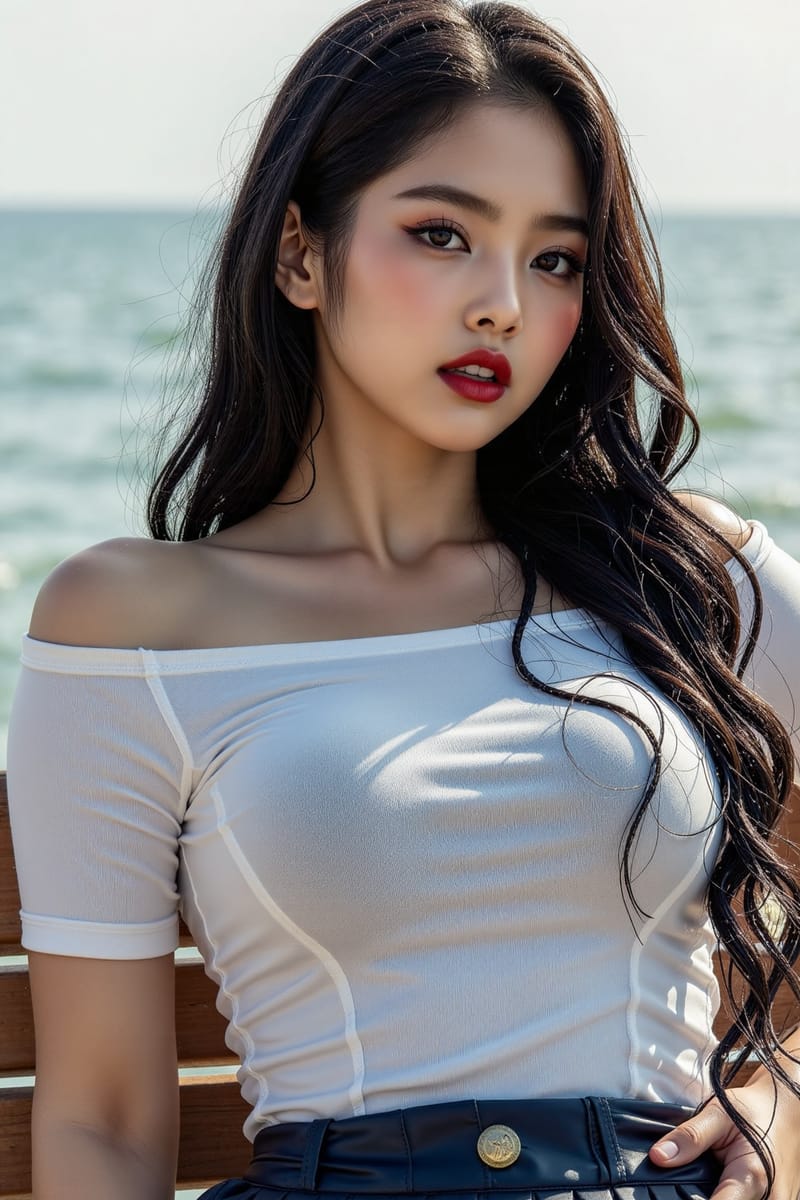
The first version will give you a flat, evenly lit, centered portrait with a generic blurred background. The face will look fine but forgettable. The second version will give you a portrait with compressed, flattering facial proportions, a creamy out-of-focus background with visible bokeh circles, and the overall feeling that a professional photographer was in the room. The only difference is 15 words.
|
|
Three variations
Three ways to use 85mm tonight.
|
|
Each of these targets a different portrait style. Copy any one and paste it directly into whatever AI tool you use.
THE EDITORIAL HEADSHOT
Close-up portrait of a man in his 40s, silver temples, wearing a charcoal wool blazer over a white crew neck. Shot on 85mm f/1.4 lens. Single window light from the left, Rembrandt triangle on the right cheek. Neutral gray background, shallow depth of field with smooth bokeh. Natural skin texture with visible pores, no retouching. Editorial quality.
THE CANDID MOMENT
A woman laughing mid-conversation at a dinner table, wine glass in hand, warm candlelight from below. Shot on 85mm f/1.8 lens. Shallow depth of field, other dinner guests blurred in the background. Candid, unposed, genuine expression caught mid-moment. Warm amber tones, slight film grain.
THE MOODY PORTRAIT
A young man looking directly at camera, half his face in shadow. Shot on 85mm f/1.4 lens. Split lighting from a single hard source on the right, deep shadows on the left half. Pure black background. High contrast, desaturated muted tones. Visible skin texture, intense expression. Cinematic and dramatic.
Notice that each prompt pairs the 85mm lens with a different lighting setup. The lens handles the face. The lighting handles the mood. Together they produce a portrait that looks like two decisions were made on purpose, which is exactly what separates professional photography from snapshots.
|
|
When not to use it
85mm is not for everything.
|
|
If you want to show the environment around the subject, 85mm is too tight. It isolates. If you want a cafe scene where the viewer can see the counter, the menu board, and the other customers, you need a 24mm or 35mm. If you want a full-body fashion shot with the city behind the model, 85mm will crop too close unless you describe a full-body framing explicitly.
Think of it this way. 85mm is for faces. 35mm is for people in places. 24mm is for places with people in them. Each lens tells a different story. The 85mm story is always about the person, never about the location.
Next week I am going to cover the one lighting setup that transforms flat AI images into something with depth and shadow. It is a technique a Dutch painter invented in the 1600s and professional photographers still use every day. If 85mm fixes the face, this fixes the light.
|
|
Coming next
How one painter from 1642 can fix your AI portraits.
The lighting technique that adds depth, shadow, and dimension to every face.
|
|
Did you try the 85mm prompt?
Hit reply and tell me if you noticed the difference. I read every response and it shapes what I write next.
Know someone who should read this? Forward this email to them.
|
|
See you next week.
|
|
Luxe Prompting
AI image generation for creators.
|
|