
 LUXE PROMPTING
ORIGINAL LUXE ARCHIVE REVISIT
3 AI Architecture Prompts, From Tide to Snow
A place can look beautiful and still be hard to understand. These three original Luxe archive scenes give us a practical way to study the route, the destination and the space between them. Revisit a tidal post office, a rooftop orchard and a snowy pavilion with their complete prompts and matching images.
Sponsored
100+ coding prompts top engineers use to ship 5X faster

Claude Code, Codex, and Cursor are on every engineer's stack. Most still treat them like a search bar. Top engineers work from a system, these 100+ prompts are that system. Sign up for The Code and get the prompts free, plus a 5-minute daily newsletter to keep sharpening your edge.
The Short Version
- Use three complete original Luxe prompts with their exact recorded images.
- Check how the route, viewpoint and doorway explain each fictional place.
- Separate what the image shows from the brief it missed, then try one focused revision.
Start with a route you can describe
These scenes first appeared in our original imaginary-places archive. This revisit adds a new reading exercise; it is not a new collection of community submissions or a popularity ranking. The original prompts remain unchanged so you can compare the actual instructions with the actual image.
Before generating anything, describe how a viewer enters the scene and what they should find. In the coastal example, the bridge is the route and the blue door is the destination. On the roof, the important relationship is the walking space around the courtyard. In the snow, the path and warm doorway work together.
Pick one scene
Choose the setting closest to your own idea. Copy its full prompt before making changes.
Name one pass condition
Use something you can inspect, such as a bridge meeting a door or a layout with countable planters.
Keep the original beside the result
Record the prompt, tool and settings you know. If a setting is unavailable, leave it unknown rather than assuming it stayed fixed.
1. Tidal post office: let the bridge explain the place
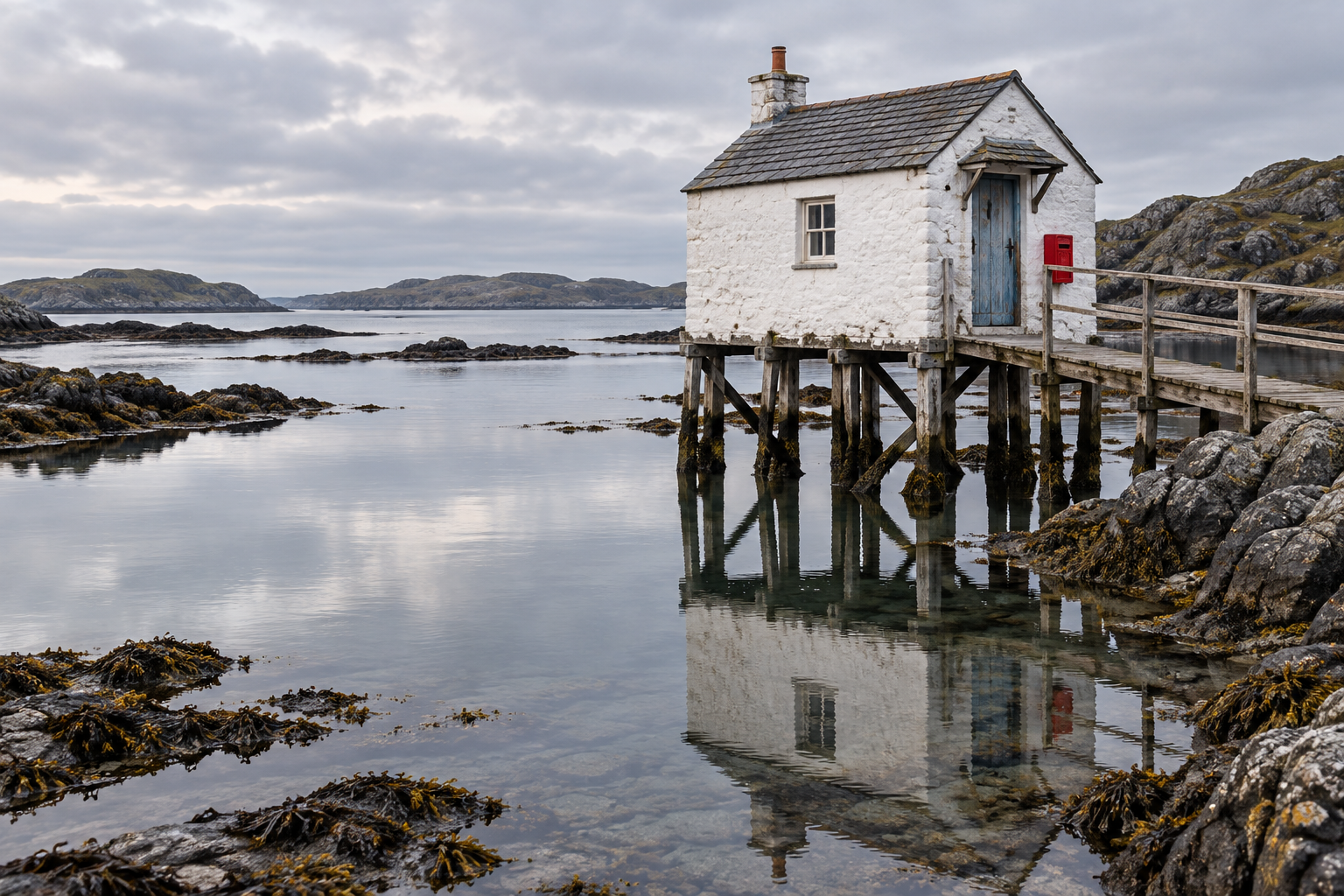
Original Luxe archive illustration. The complete recorded generation prompt follows unchanged.
Create a landscape 3:2 architectural concept photograph of a fictional tiny post office standing on slender timber stilts above a calm coastal tidal pool. The building is simple, with white limewashed walls, a weathered blue door, one small window and a narrow wooden access bridge from the rocky shore. Include a modest unlettered red post box beside the door. Use a distant three-quarter view at low tide under soft overcast daylight; reflections and exposed dark rocks establish the water level. Restrained slate, chalk and muted blue colors, believable timber connections and a clear path to the entrance. The building should occupy the right half with open reflective water on the left. No people, readable signs, logos or watermark.
Read the recorded result
The bridge reaches the blue door, the building sits to the right and open water gives its reflection room. Those relationships make the tiny office easy to understand. The supports are much heavier and more braced than the slender timber requested in the prompt.
One experiment to try
For a later attempt, keep the camera and shoreline fixed. Change only the description of the supports, then check whether the bridge still meets the doorway. The image shown is the recorded original, not a demonstration of that revision.
A useful check
Trace the route from shore to threshold. A strong texture or reflection does not compensate for a path that loses its destination.
2. Rooftop orchard: use camera height to reveal the layout
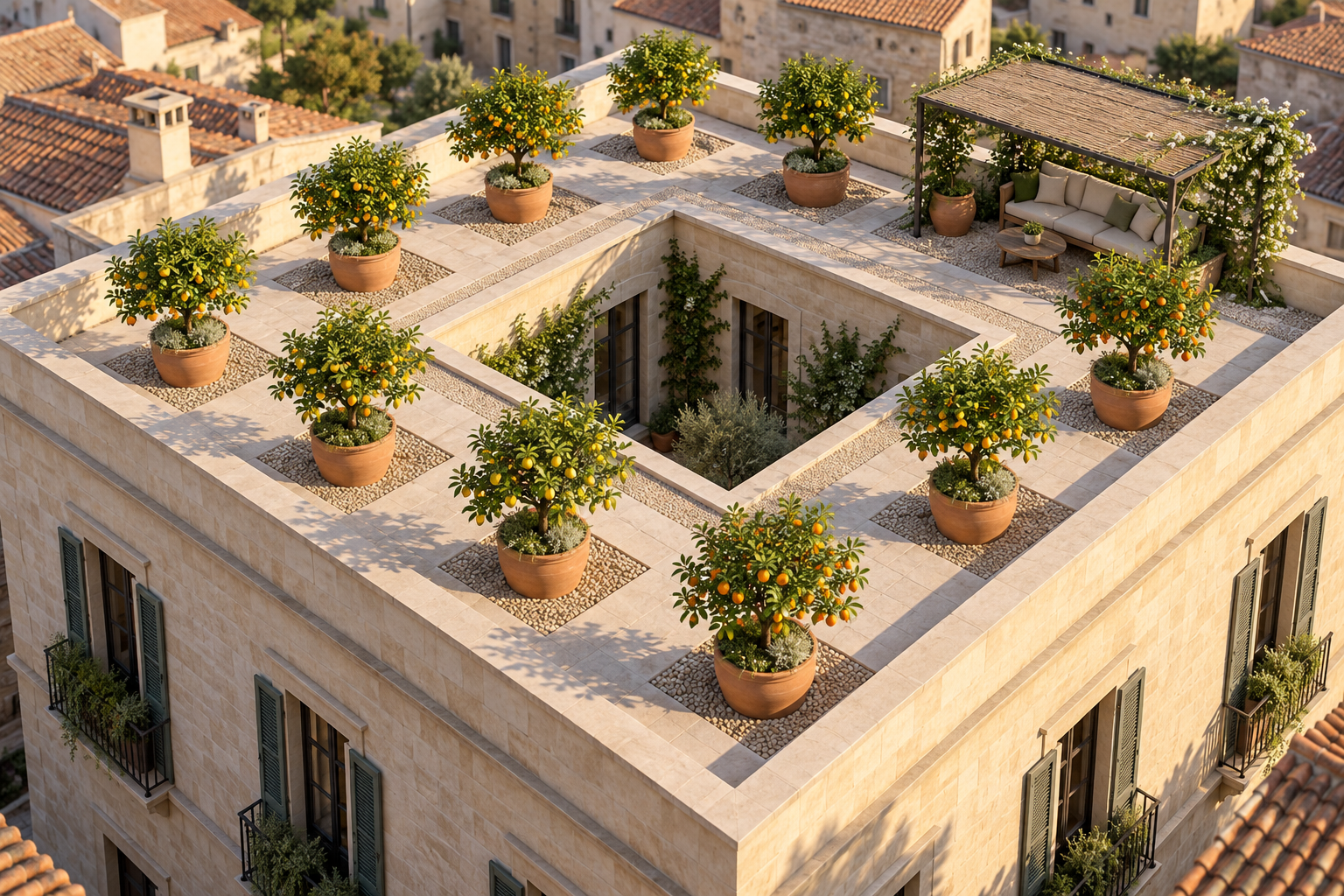
Original Luxe archive illustration. The complete recorded generation prompt follows unchanged.
Create a landscape 3:2 aerial editorial photograph of a fictional compact city courtyard building whose flat roof contains an orderly miniature citrus orchard. Show a square pale-stone roof around a small central open courtyard, twelve evenly spaced large terracotta planters with small fruiting citrus trees, a simple walking path and one shaded seating nook. Use a high oblique viewpoint that reveals the roof layout and part of two exterior walls, warm early-morning light and believable short tree shadows. Surrounding rooftops remain simple and subordinate. The roof must look level, the paths connected and the trees visibly contained in planters. This is an imaginative architectural illustration, not a construction plan. No people, text, logos or watermark.
Read the recorded result
The high view makes the central courtyard, terracotta planters and seating nook visible together. The connected strips of paving give the roof a readable layout. The requested count of twelve planters is not clearly established in this view; attractive repetition is not proof of an exact count.
One experiment to try
If the number matters in your own version, treat it as a separate pass condition. Keep the viewpoint and morning light, then ask for a simpler arrangement you can count without hidden pots. Do not label a new result correct until you have counted what is actually visible.
A useful check
Follow one path around the courtyard before inspecting the leaves. Look for places where overlapping foliage makes separate planters difficult to distinguish.
3. Snowy tea pavilion: connect the path to the light
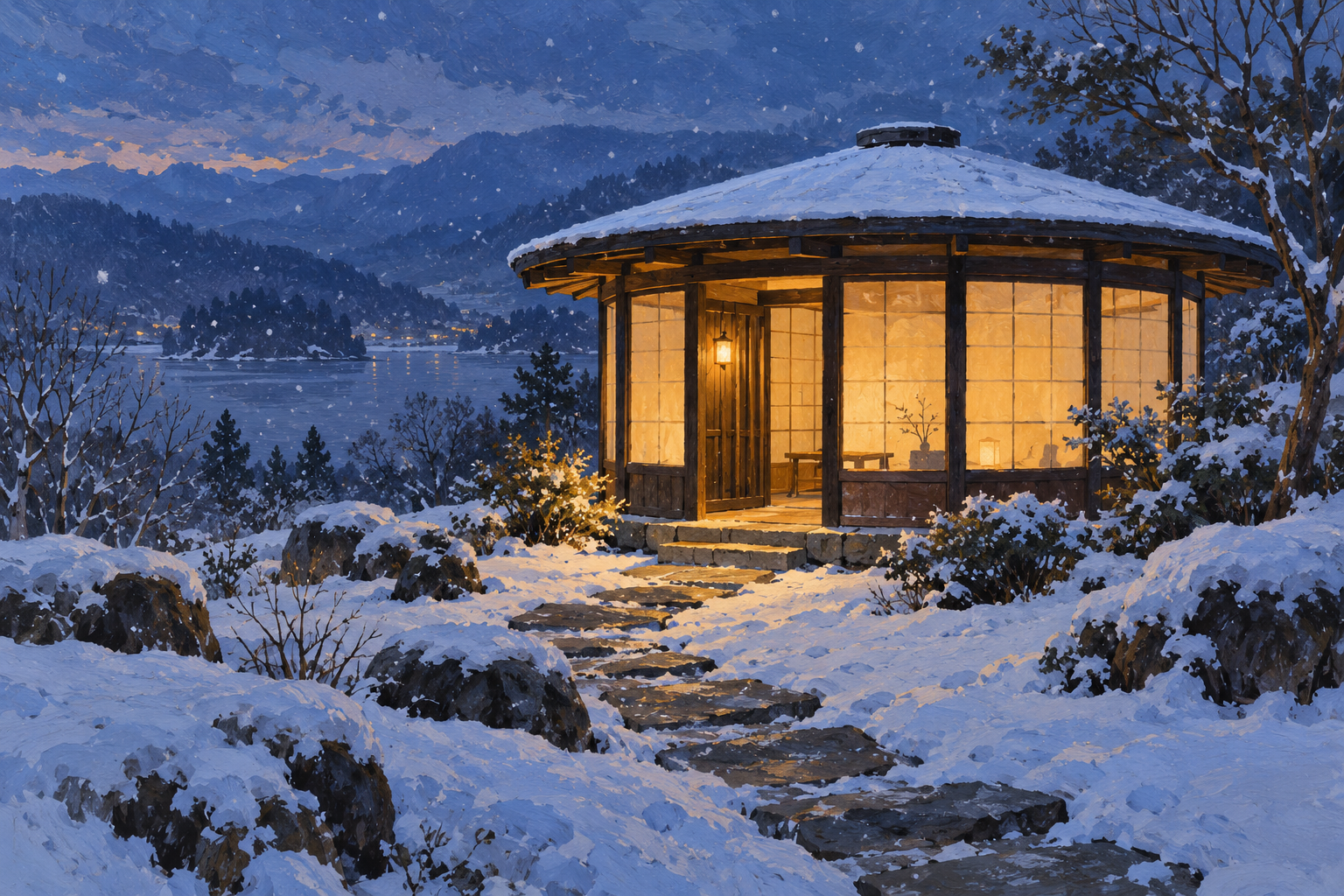
Original Luxe archive illustration. The complete recorded generation prompt follows unchanged.
Create a landscape 3:2 gouache architectural painting of a fictional small circular tea pavilion in a snowy landscape at blue hour. The building has a dark timber frame, broad translucent paper-like window panels and a shallow curved roof capped with a thin layer of snow. Warm golden light glows gently through the windows, contrasting with the cool blue snow and distant indigo hills. Show a clear short stone path leading to a single visible doorway. Use a low eye-level three-quarter view, confident broad brushwork, restrained detail and soft falling snow. Keep the building modest and inviting, with a realistic grounded shadow and no floating elements. No people, lettering, logos or watermark.
Read the recorded result
The stone path leads toward the lit doorway, and warm window panels stand apart from the blue snow. The result adds a lake and distant settlement beyond the requested hills. It remains inviting, but that added background is a choice made in the result rather than a requirement of the brief.
One experiment to try
To test a quieter setting, preserve the pavilion, path and warm interior. Change only the distant background to plain snowy hills without buildings. Compare the two versions at the same size before deciding which setting better supports your scene.
A useful check
Find the doorway at thumbnail size, then follow the path toward it. The destination should stay readable even when small brush details disappear.
Make a small scene card before the next attempt
Save the baseline and the revision as separate files. A rerun can change more than the sentence you edited, so this is a practical comparison rather than proof that one phrase caused every difference. These images are fictional concept art, not documentation of real buildings or construction plans.
Route
Write where the eye starts and how it reaches the important place.
Destination
Name the door, seat, activity or object that gives the route a purpose.
Viewpoint
Choose what the camera must reveal. A low view can show a welcoming entrance; a high view can make a layout easier to inspect.
One detail to verify
Select a count, a connection or a framing requirement. Judge that detail separately from whether you like the overall atmosphere.
Try one route, then explain what happened
Choose one of the three prompts and write your scene card. After generating, compare the route and destination before adding more decorative detail. If you share your own result, include the complete prompt and one sentence about a requirement it met or missed. That gives another creator something specific to learn from.
Source Desk
All three prompts and matching images are original Luxe archive work, previously included in our imaginary-places collection. New observations and revision exercises are editorial guidance, not new generated results. No Facebook authorship, popularity ranking or model benchmark is claimed.
A clearer brief. A more useful result.