In partnership with

 LUXE PROMPTING
ORIGINAL LUXE ARCHIVE WORKSHOP
5 AI Image Prompts for More Believable Materials
A convincing material needs more than the word realistic. It needs an edge, a surface and a useful relationship with light. These five original Luxe prompts explore glass, ceramic, cut paper, velvet and mosaic. Each includes its recorded image, a visible limitation and one focused experiment for your next attempt.
Your SOC 2, handled end to end with AI agents.

Enterprise buyers won’t put your product near their customer data without a SOC 2 report. Twenty-one state privacy laws now hold them accountable for the vendors they share data with, so their diligence lands on you.
Sprinto gets you audit ready in 14 days, across three working sessions. AI agents connect your stack, collect the evidence auditors ask for, and close the gaps as they appear. You approve, they execute.
Sprinto also answers the security questionnaires your buyers send, using the same evidence base, so security reviews stop holding up deals.
No compliance hire. No consultant. Your auditor signs off.
The Short Version
- Copy five complete original Luxe prompts with their matching generated images.
- Read material through edges, contact points, reflection and large shapes.
- Use the proposed revisions as experiments. The images below are the recorded originals, not results of the new edits.
Start with the material boundary
Pick one example and make a baseline before changing it. Save the complete prompt, model or tool name, settings you can control and the resulting file together. These images come from our September archive; they are selected for this workshop and are not a ranking of community posts.
Look at where two surfaces meet: glass against ceramic, cloth against water or a folded sheet against its base. If that boundary is unclear, adding more texture words may simply make the uncertainty busier. Choose one concrete defect, then make one edit that addresses it.
1. Glass and ceramic: give each surface a different job
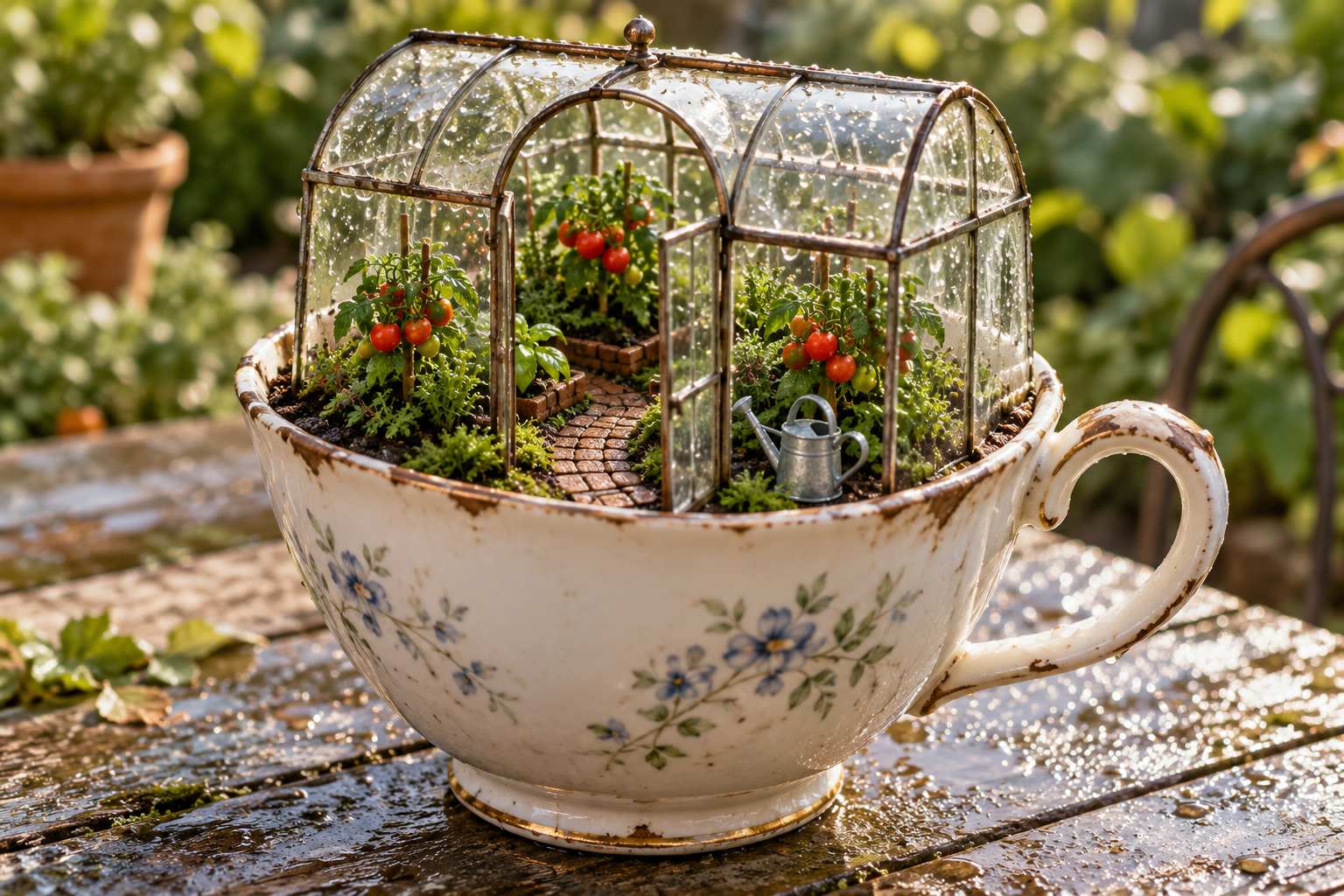
Original Luxe archive image generated from the exact complete prompt below.
Create a landscape 3:2 macro photograph of a handmade miniature greenhouse built inside a chipped white porcelain teacup on a weathered garden table. A small arched glass roof rises just above the cup rim, with three tiny tomato plants, a narrow brick path and one miniature watering can visible inside. Retain the unmistakable handle and curved cup silhouette. Photograph from a slightly elevated three-quarter angle in soft morning light after rain; clear droplets cling to the glass, and distant garden leaves blur into gentle green shapes. Show believable ceramic, glass, soil and leaf textures, with the greenhouse central and the handle clearly separated from the background. Whimsical but physically coherent scale. No people, writing, logos or watermark.
What the recorded image shows
Droplets and bright reflections make the roof read as glass, while the cup keeps a solid curved outline and worn glazed surface. The open doorway lets us see the brick path. The greenhouse rises much higher than the requested cup-rim height, so texture fidelity has not solved the scale instruction.
One edit to try
Keep the composition and morning light. Change only the roof-height instruction to a low glass canopy that barely clears the cup rim. Compare whether the plants remain readable without losing the teacup silhouette.
What to inspect
Trace the rim, handle and glass frame. Look for a continuous edge and a believable place where one material meets another.
2. Cut paper: use edges and shadows to show the craft
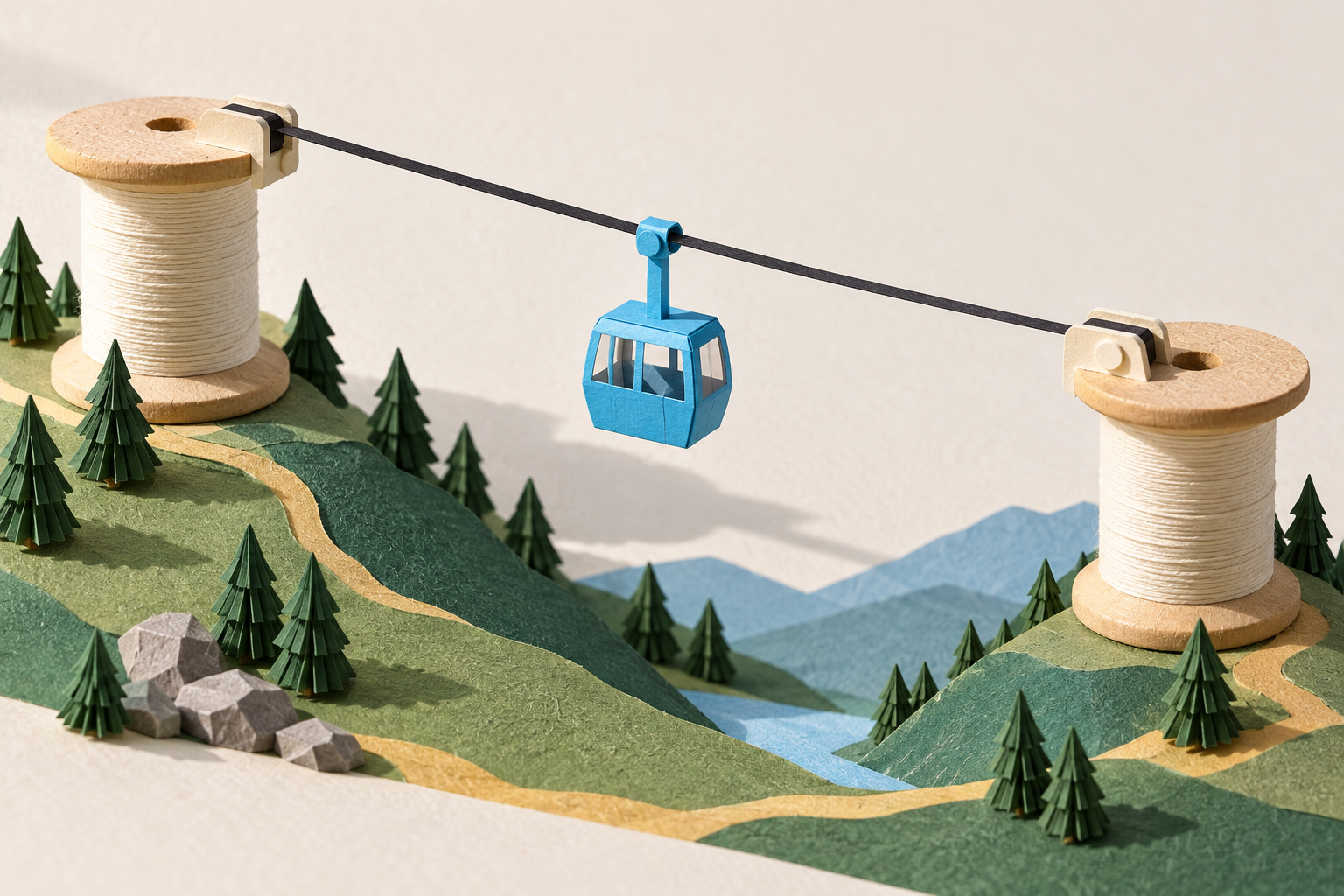
Original Luxe archive image generated from the exact complete prompt below.
Create a landscape 3:2 cut-paper illustration of a tiny cable-car route stretched between two large wooden sewing spools on a craft table. Layer colored paper into a convincing shallow stage set: two cream spools form stations, a taut dark paper cable joins their tops, and one bright blue folded-paper cabin hangs halfway across. A few thread-like green strips form small hillside trees below. Use an elevated side view, crisp cut edges, visible paper fibers and short soft shadows from a light above the left. Limit the palette to cream, pine green, sky blue and muted ochre on a pale background. The miniature cabin should be immediately recognizable. No text, logos, watermark or extra cable lines.
What the recorded image shows
The blue cabin has clear folds and a readable silhouette. Layered green hills, folded trees and short shadows make the scene feel assembled. The result adds a fuller landscape than the few strips in the brief, shifting attention away from a simple craft-table model.
One edit to try
Keep the two spools, cabin and cable. Reduce only the scenery to three folded trees on one flat paper base. Compare whether the construction is easier to understand without changing the cabin color.
What to inspect
Inspect the cabin hanger and cable connection. A pleasing paper texture should not hide a disconnected or ambiguous support.
3. Velvet and water: separate soft, rough and reflective
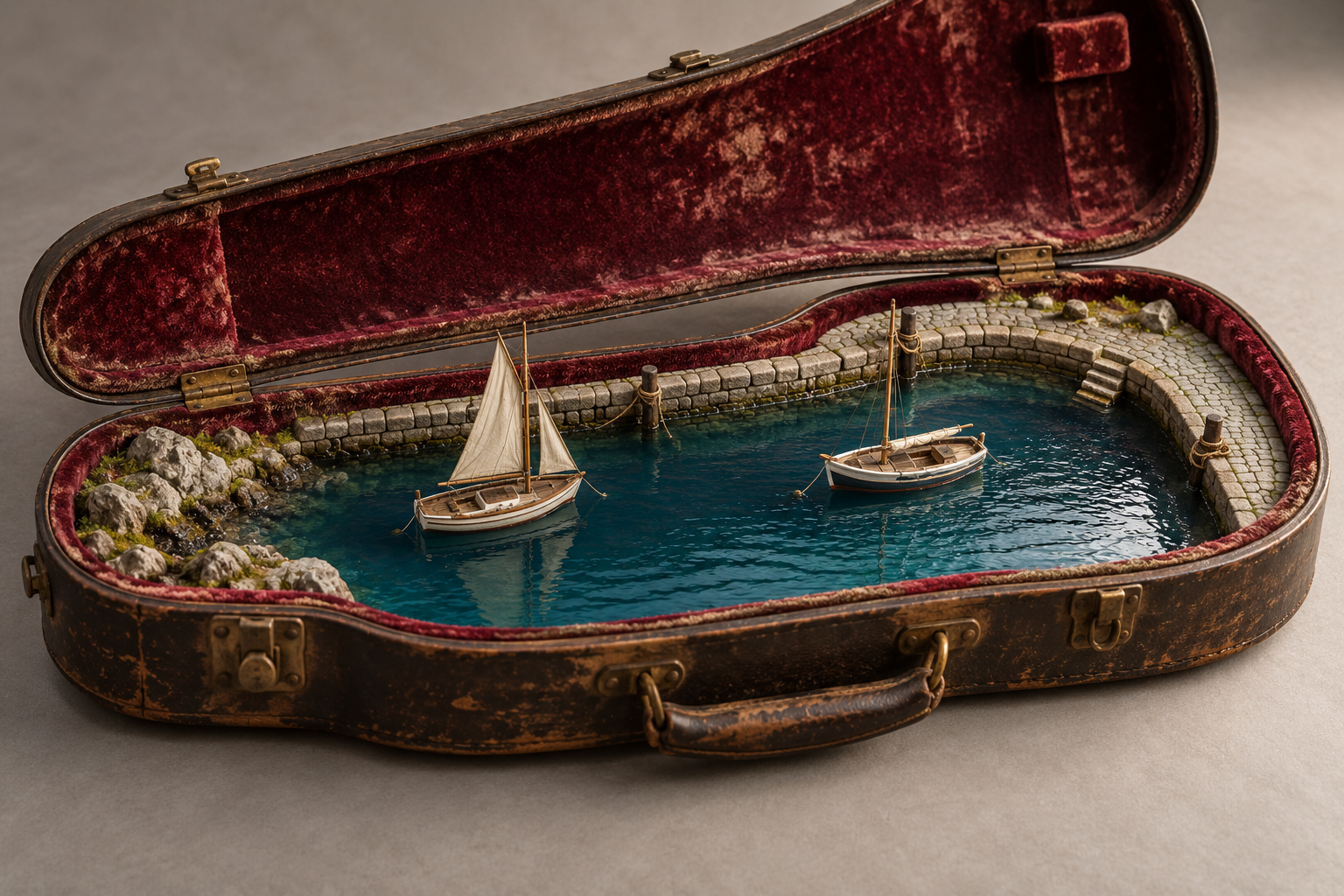
Original Luxe archive image generated from the exact complete prompt below.
Create a landscape 3:2 sculptural 3D illustration of an old open violin case transformed into a miniature sheltered harbor. The case lies horizontally on a neutral warm-gray studio surface; its curved velvet-lined interior contains calm deep-blue water, two tiny wooden sailboats and a short stone quay following the inner edge. The open lid rises behind like a protective wall, retaining visible hinges and worn fabric. Use an elevated three-quarter view so the case remains recognizable and the boats are clearly separate. Light the scene with a broad soft studio light from the upper right and subtle reflections on the water. Rich tactile felt, aged wood and small stone details. No violin, people, text, logos or watermark.
What the recorded image shows
The red lining looks soft beside the rough stone quay, and small highlights give the blue water a separate surface. Two boats remain distinguishable. The long rounded case does not have a strongly pinched violin-shaped waist, so the container identity remains less precise than the brief.
One edit to try
Keep the boats, camera and lighting. Strengthen only the violin-case outline, asking for a narrow waist between two rounded lobes. Judge that silhouette before judging the fine felt texture.
What to inspect
Follow the shoreline and each boat outline. The fabric should stop at the water boundary instead of turning into a repeated texture across everything.
4. Folded paper: distinguish a sheet from a solid object
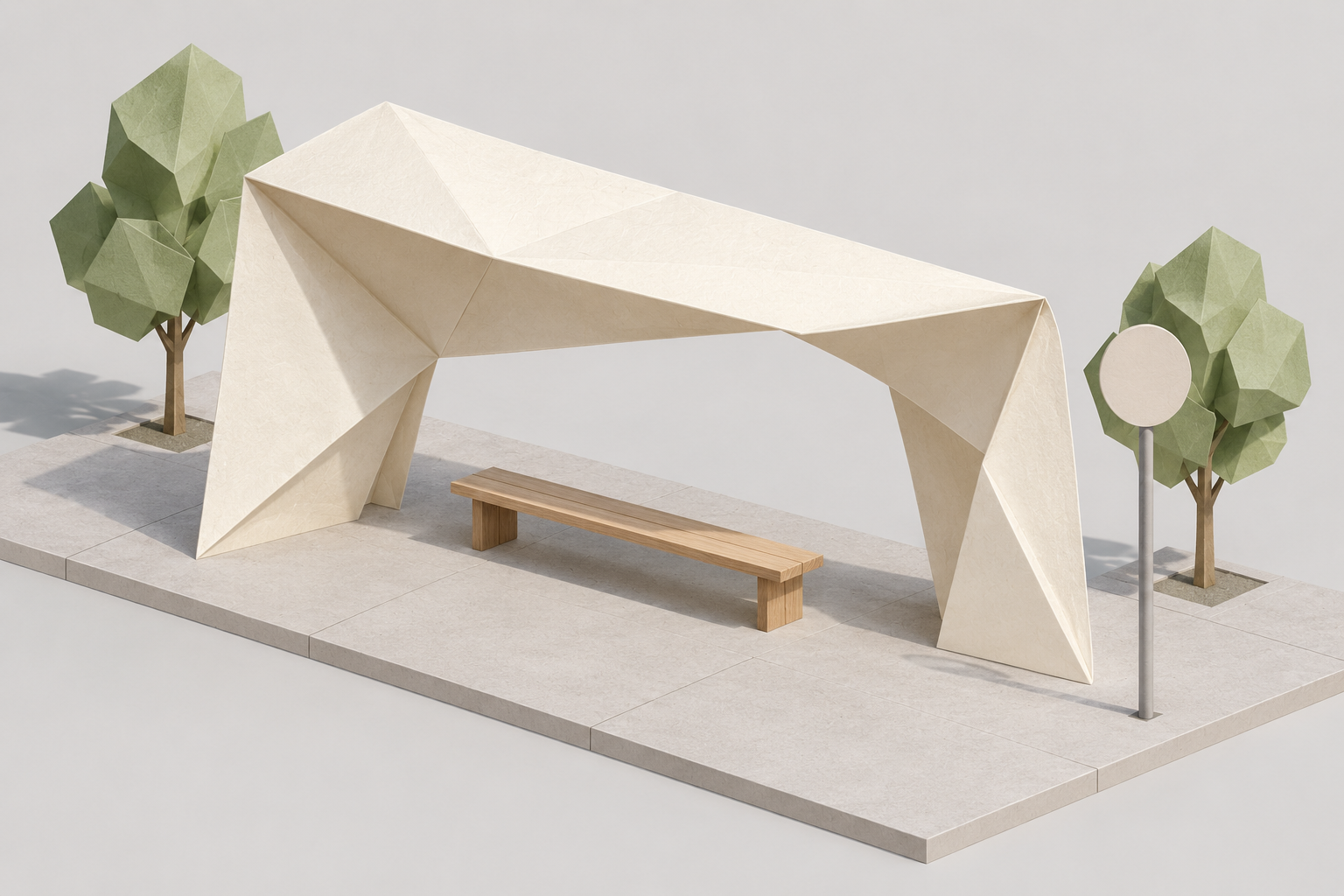
Original Luxe archive image generated from the exact complete prompt below.
Create a landscape 3:2 architectural illustration of a fictional bus shelter made from one enormous folded sheet of warm ivory paper in a quiet urban square. The folded roof and two supports must read as a single continuous origami form, with subtle creases and softly visible paper texture. Place one simple timber bench underneath and a single plain circular bus-stop marker nearby, without lettering. Render as a clean isometric cut-paper model with soft midday studio shadows on a pale gray base; add two small sage-green paper trees for scale. Keep the shelter entrance clear, the bench fully visible and the composition spacious. No vehicles, people, writing, logos or watermark.
What the recorded image shows
The roof and supports read as a connected folded form, with a visible bench and blank circular marker. The ivory surface has a subtle grain. Its thick edges feel closer to a solid architectural model than a single thin sheet of paper.
One edit to try
Leave the shape and isometric view fixed. Replace only the material description with thin card whose exposed edges show a narrow layered thickness. Check the fold junctions before adding more surface detail.
What to inspect
A fold should connect two planes. Inspect whether the thickness stays consistent at the roof edge, supports and ground contact.
5. Mosaic: let small pieces describe large forms
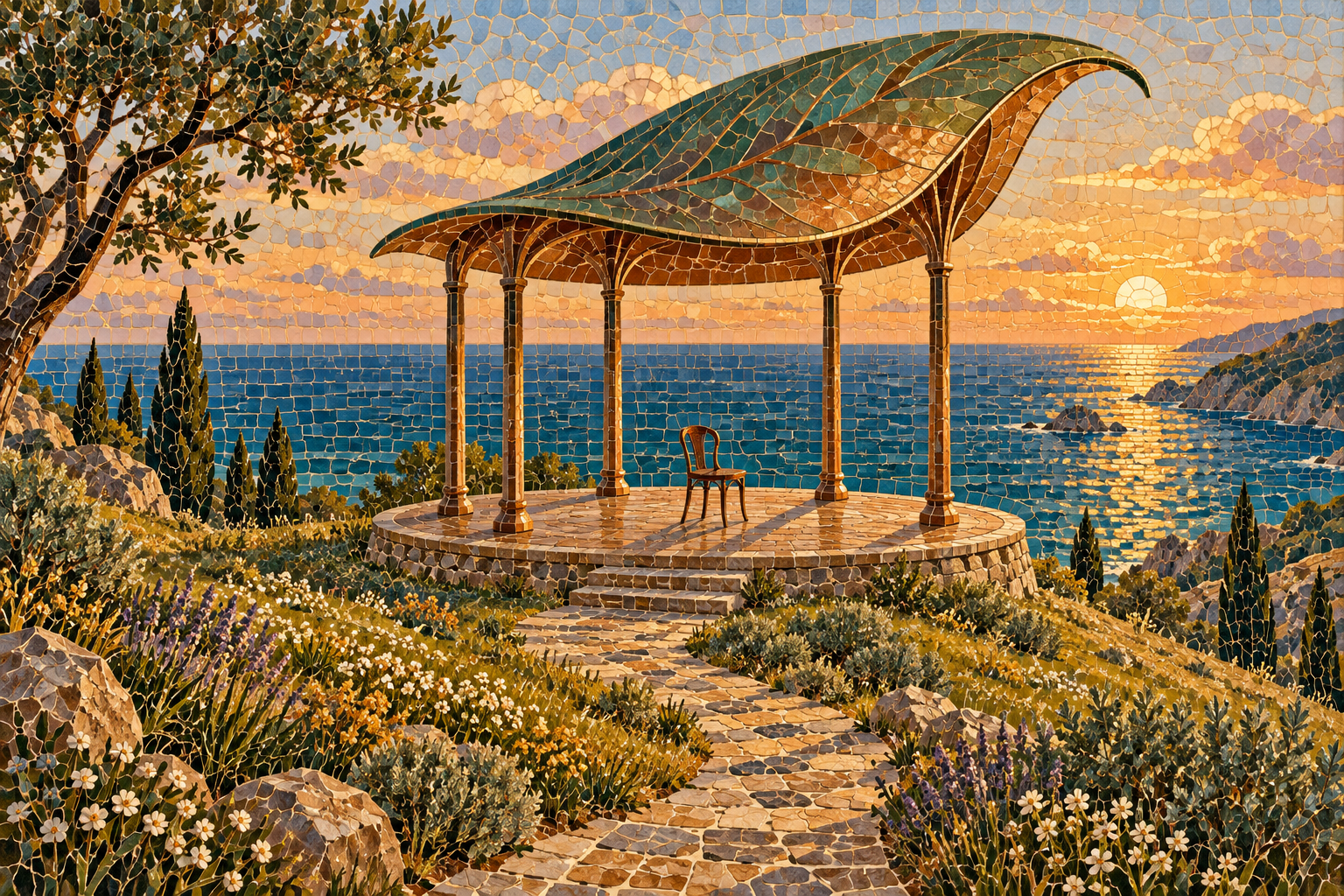
Original Luxe archive image generated from the exact complete prompt below.
Create a landscape 3:2 mosaic-style illustration of a fictional open-air music pavilion on a grassy hill above the sea. Build the image from small irregular ceramic tile shapes with visible pale grout. The pavilion is a simple circular timber platform with six slender columns and a sweeping leaf-shaped copper roof, open on all sides. A single empty wooden cello chair stands at the center, without instruments or people. Use a slightly elevated frontal composition, late-afternoon golden light suggested through warm tile colors, deep teal sea and pale peach clouds. Keep the platform edge, all supporting columns and the path up the hill visually coherent. Decorative but readable architectural storytelling. No text, logos or watermark.
What the recorded image shows
Tile boundaries remain visible across the leaf-shaped roof, sea and clouds. The empty chair gives the scene a clear center. Only five columns are clearly visible, and the platform looks stone-clad despite the requested timber. A consistent mosaic style can still miss count and material instructions.
One edit to try
Preserve the scene and palette. Change only the platform material to clearly separated brown timber boards, still represented by ceramic tile shapes. Compare whether it reads as timber at thumbnail size.
What to inspect
First read the roof, chair and platform as large shapes. Then inspect grout and tile scale. Extra detail is useful only while the scene stays legible.
Run one small material experiment
A rerun can change several details even when you change one sentence. Treat this as a practical comparison, not proof that one word caused every difference. Save the result you rejected too, with one short reason. That gives your next attempt a useful starting point.
- Choose one prompt and save a baseline image with the exact text.
- Write a pass condition, such as a continuous glass frame or a clearly thinner paper edge.
- Change one material or structure instruction. Keep other settings consistent where the tool allows.
- Compare both images at the same size, then zoom into the material boundary.
- Keep the revision only if it improves the chosen detail without making the main subject harder to read.
Make your next post easy to learn from
If you share your own experiment, include the complete prompt, the result and one sentence about what you changed. Label any reference image or later edit. A short honest note about a missed instruction is often more useful to another creator than an unexplained claim of perfection.
Source Desk
All five prompts and images are original Luxe archive work with recorded generation and image receipts. New revision exercises are editorial suggestions, not demonstrated outputs. No Facebook authorship, popularity ranking, model benchmark or architectural buildability is claimed.
A clearer brief. A more useful result.