In partnership with

 LUXE PROMPTING
LUXE CREATOR WORKFLOW
A 5-Minute Review Before You Share an AI Image
You can like an image and still learn from what it missed. Before posting, spend five focused minutes checking the brief, the main subject and the details that matter. This review routine gives you a useful next edit and helps other creators understand what your result actually demonstrates.
AI research, explained in one morning email

Most of what shapes AI next year is sitting in a research paper today. Keeping up with them is a full-time job, and the abstracts don't help.
TLDR AI is the newsletter that does the translating. Each morning you get the handful of papers worth knowing about, curated by Anthropic and ex-Google engineers, with a plain-English summary of what they found and why it matters.
You come away smarter about AI research in the time it takes to finish your coffee.
Free, and delivered to 1.1M+ inboxes every morning.
The Short Version
- Keep the complete prompt and its exact image together before comparing versions.
- Separate a visually appealing result from one that follows the brief.
- Share one clear success, one limitation and the change you would try next.
Minute 1: recover the brief, not your memory of it
Open the actual prompt next to the image. If it lives in a comment, keep the direct comment or post link with the author credit. Do not quietly replace missing text with what you think the prompt probably said. A caption, an image description and a generation prompt can be three different things.
Write down the three requirements that mattered most. For a character scene, these might be the action, the camera distance and the object being handled. For a product image, they could be shape, label accuracy and the surface below it. Use the brief to decide what counts as a meaningful miss.
Minute 2: check the image at the size people will see it
Shrink the image to a phone-sized preview. Say what you notice first in one sentence. If the important subject disappears or a background detail takes over, note that before zooming in. A sharp image can still have an unclear visual hierarchy.
Now read the three requirements you wrote down. Mark each as met, missed or uncertain. Uncertain is useful: a cropped hand is not evidence of a correct hand, and an unseen side of an object cannot establish that its shape is accurate.
A real example: atmosphere can succeed while framing misses
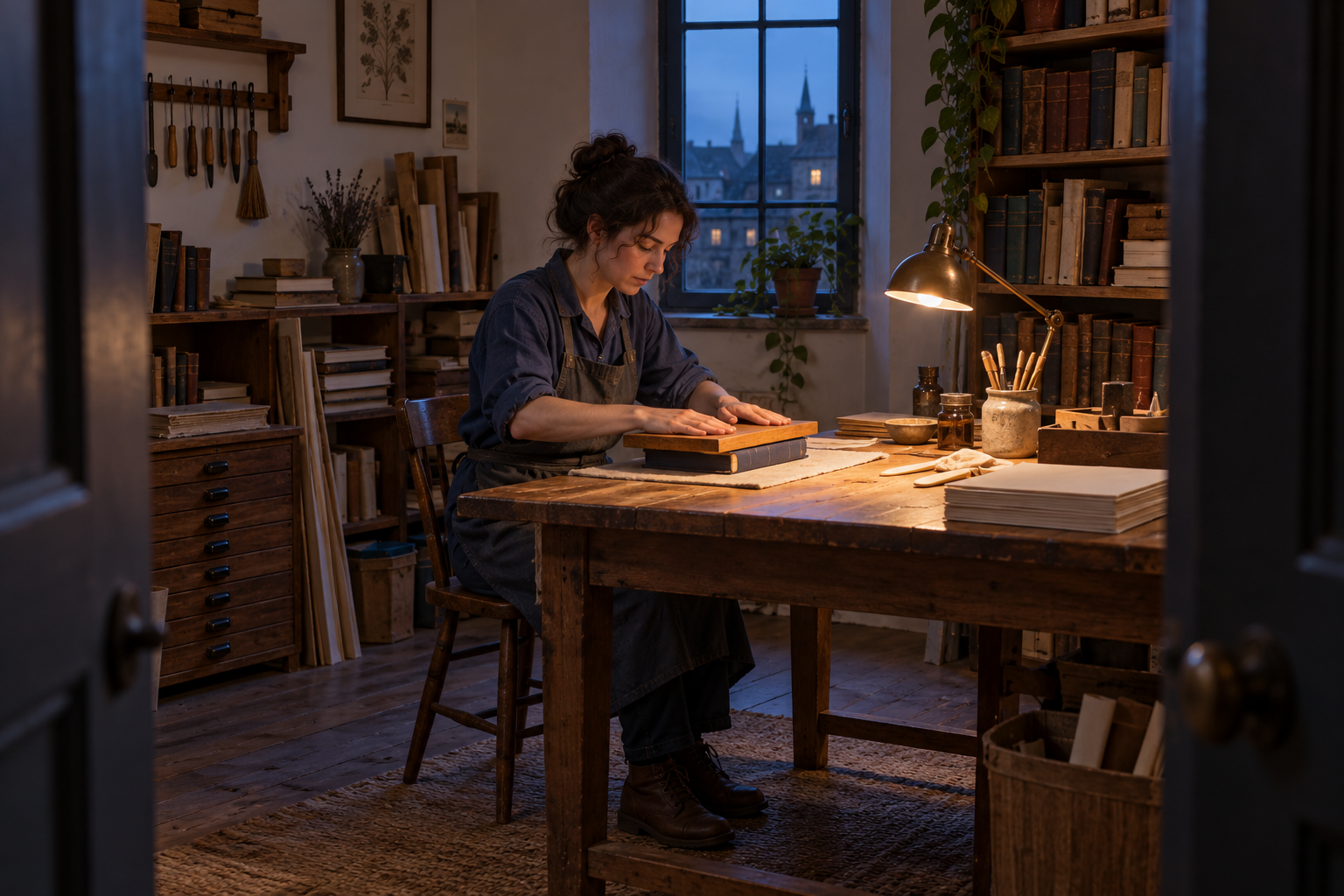
Original Luxe archive illustration, shown here as a review example. This is a fictional scene, not a photograph of a real workshop.
In this recorded Luxe example, the warm desk lamp makes the bookbinder’s hands and finishing board easy to find. The cool window and dark doorway give the room a clear evening atmosphere. Those are visible strengths worth preserving.
The original brief also asked for the complete seated person and table to fit comfortably in frame. The table reaches the right edge and hides part of the lower body. That is a framing limitation even though the scene looks convincing. A useful next experiment would adjust the camera distance while preserving the light and action.
Minute 3: inspect the places where objects meet
Zoom into hands holding objects, feet meeting the floor, straps meeting clothing and reflections near edges. Trace one connection all the way through. Do the parts continue in a way you can understand? A material may look polished while the physical relationship remains ambiguous.
Avoid a hunt for every possible flaw. Prioritize the details that support the intended story. If the image is about a person repairing a violin, the hand, tool and instrument deserve more attention than a distant wall hook. Write a concrete observation such as the thumb merges with the handle, not simply the image looks wrong.
Minute 4: choose one revision and preserve the baseline
Name one thing to keep and one thing to change. For the bookbinder, keep the warm task light and change the camera distance. For a miniature, keep the container silhouette and change the interior height. This makes the next comparison easier to read.
Save the original before editing. Keep the exact revised text and result in a separate version. If your tool exposes a seed, reference strength or model version, record it. If it does not, leave that field unknown. Do not describe a new image as a controlled comparison when the underlying settings changed in ways you could not track.
Minute 5: share a small, honest result note
For someone else’s work, keep their credit and source link with the example and confirm the reuse terms before reposting the image. If you reconstruct a possible prompt by looking at an image, label it as your interpretation. It should never be presented as the creator’s exact original.
What I tried
State the intended image or the single revision in plain language.
What I used
Include the complete prompt, the tool or model if known, and whether a reference image or edit was involved.
What worked
Point to one visible result, such as a readable silhouette or a clear object interaction.
What missed
Name one limitation without guessing why it happened.
What I will try next
Propose one change and the visual check you will use to judge it.
Keep a result log you will actually reuse
A plain folder and a short note are enough to start. Store the image, complete prompt, source or creation date, tool information and the five-line review together. Give revisions a clear order so you do not accidentally compare a later edit with the wrong text.
The next time a beautiful image catches your attention, save the evidence that makes it teachable. Popularity can tell you that people responded to a post; it cannot tell you whether the prompt is complete, the image is reproducible or a specific technique caused the response. Your review should answer the smaller questions it can actually support.
Try it with one image today
Choose one result you were about to share. Spend one minute on each check, then write your five-line result note. If you post a revision, keep the baseline nearby and describe the exact change. The aim is a more useful conversation about the image you made.
Source Desk
This is an original Luxe editorial workflow, informed by our local source-review practice. The bookbinder illustration and its exact generation record come from the Luxe archive. No new model test, community quotation, popularity ranking or guaranteed improvement is claimed.
A clearer brief. A more useful result.