In partnership with

LUXE PROMPTING
THE RAIN & REFLECTION WORKSHOP
3 AI Prompts for Rain That Tells a Story
Rain can do more than make a scene darker. A puddle can repeat a warm light, a few rings can suggest quiet movement, and a bright coat can hold your attention. These three original Luxe prompts turn weather into a visual decision, with fresh AI-generated images and an honest look at what worked.
Nobody's coming to approve your idea

People assume that real businesses get built by other people with more resources. It's how great ideas get stuck in notes apps and conversations.
But you don't need six months and a developer's salary to validate your concept. You just need a weekend. Describe what you want to exist and Lovable builds it: a real site, a real product, ready to accept real payments from real customers. Not a mockup to show people. An actual thing they can use.
You don't need anyone's sign-off to get started. Take $5 off your first month.
Discount of $5 applies to first month of any paid plan. You need to sign up via this webpage in order to claim the discount. The discount applies to new and returning users without an active paid plan. Terms apply.
The Short Version
- Choose one weather cue: a broken reflection, a rain ring or a clearly directed paper raindrop.
- Give the subject priority through warm light, sharp detail or a single accent color.
- Check where reflections begin, what they repeat and whether the weather obscures the story.
Start with the story, then add the weather
Copy a complete prompt below into your image tool. These examples were generated for this issue; they are not photographs of actual places or a claim that every model will return the same result. Make one first attempt with the prompt intact. For your next version, change only the control suggested beside that example.
1. Let a puddle carry the warm light
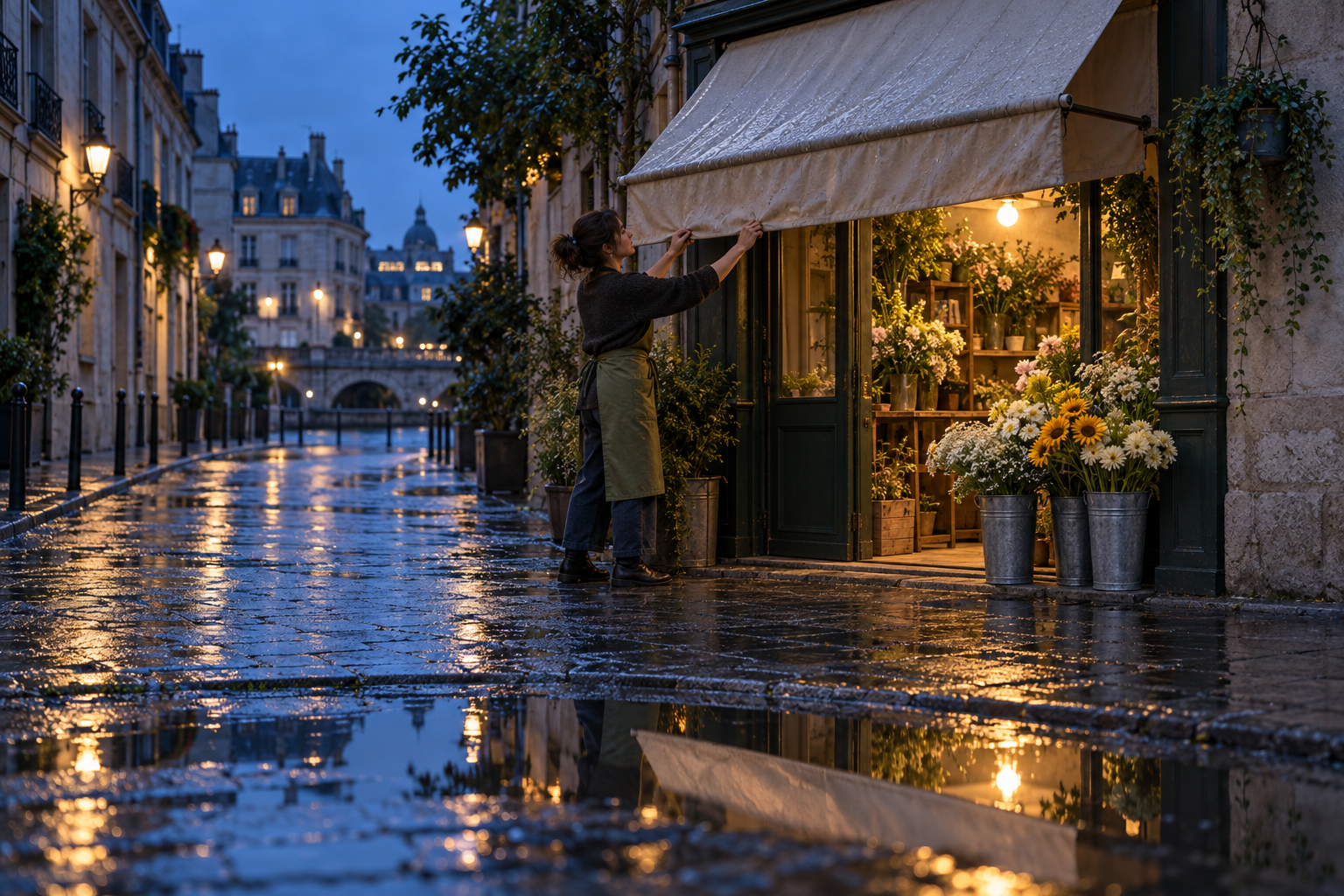
The action is small: a florist closing for the evening. Warm light under the awning gives that action a home, while the cool street and foreground puddle extend the mood. The key instruction is not just rainy street; it is a reflection positioned beneath a named light source.
The image and exact prompt
Original Luxe AI-generated example, created for this issue.
Create a landscape 3:2 photorealistic editorial photograph of a tiny neighborhood flower kiosk at blue hour just after rain. One fictional adult florist in a plain moss-green apron is pulling a cream canvas awning closed, with both hands naturally gripping its bottom edge. Three metal buckets of simple white and yellow flowers stand beside the doorway. Photograph from across the narrow street at eye level, with the whole kiosk and the florist's feet visible. A single warm bulb under the awning lights the flowers; cool blue ambient light fills the street. Place a shallow puddle in the foreground so its broken reflection shows the warm bulb and awning, aligned below their real positions. Wet paving has irregular highlights, not a perfect mirror. Keep the florist and flowers readable, with the opposite buildings quiet and softly detailed. Fine rain droplets cling to the awning but no heavy falling rain. No readable signs, logos, text, watermark, neon colors or extra people.
What the result did
The warm bulb, flowers and florist form a readable cluster, and the awning appears in the puddle below. The result adds a busy street of lamps and detailed buildings, so the background is more elaborate than the brief's quiet setting.
One change to try
Keep the florist, awning and puddle. Replace the background description with two softly blurred, unlit facades to see whether the main action becomes clearer. This follow-up is a suggestion, not another generated result.
2. Make a quiet scene move with three rain rings
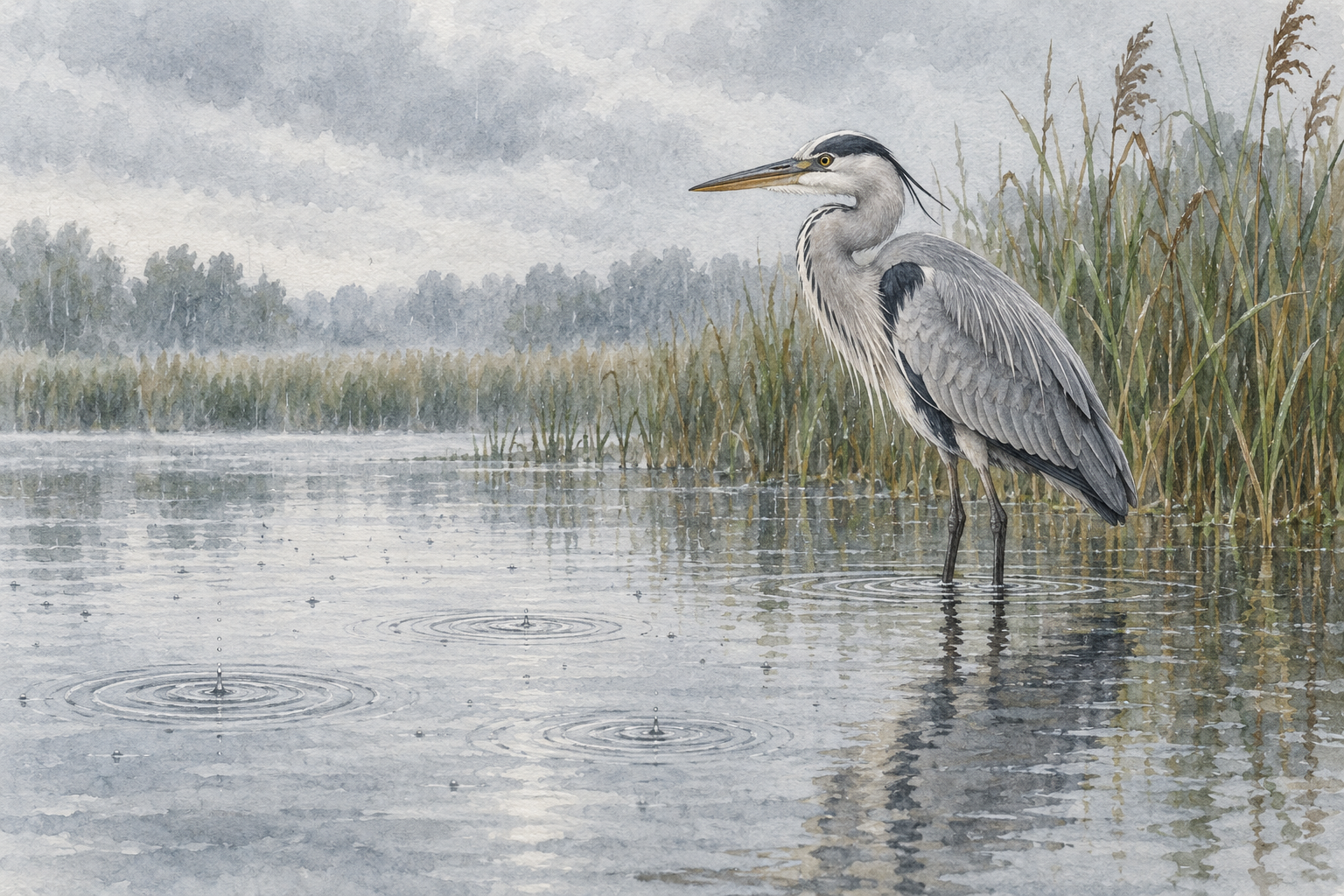
For a calmer image, remove the bright lights and give the weather a smaller job. The heron supplies a clean silhouette. The open water gives the rain somewhere to register without covering the bird in a curtain of streaks.
The image and exact prompt
Original Luxe AI-generated example, created for this issue.
Create a landscape 3:2 watercolor and graphite illustration of one grey heron standing ankle-deep at the edge of a quiet reed marsh during light rain. Show the full bird in side profile near the right third, its long neck loosely folded and its beak pointing left. Use a low viewpoint just above the water. A pale open patch of water occupies the left half, with three small groups of expanding rain rings breaking the heron's faint reflection. Paint distant reeds as soft sage and slate washes; reserve the sharpest graphite edges for the eye, beak and two thin legs. The overcast sky provides diffuse light without a sunbeam or sunset. Let the paper grain and a few transparent blooms remain visible. Keep the scene spacious and natural, with one bird, a clear waterline, restrained detail and believable contact between feet and water. No lettering, borders, logos, watermark or decorative splashes outside the scene.
What the result did
The full bird and waterline are clear, with three large ripple groups leading across the open foreground. Fine feather and reed detail is richer than the restrained brief, but the pale water still gives the image breathing room.
One change to try
Keep the bird and ripples; simplify the far reeds into two broad washes. Compare the image at thumbnail size and ask whether the heron still reads before the background. The suggested revision has not been generated.
3. Translate the weather into the material
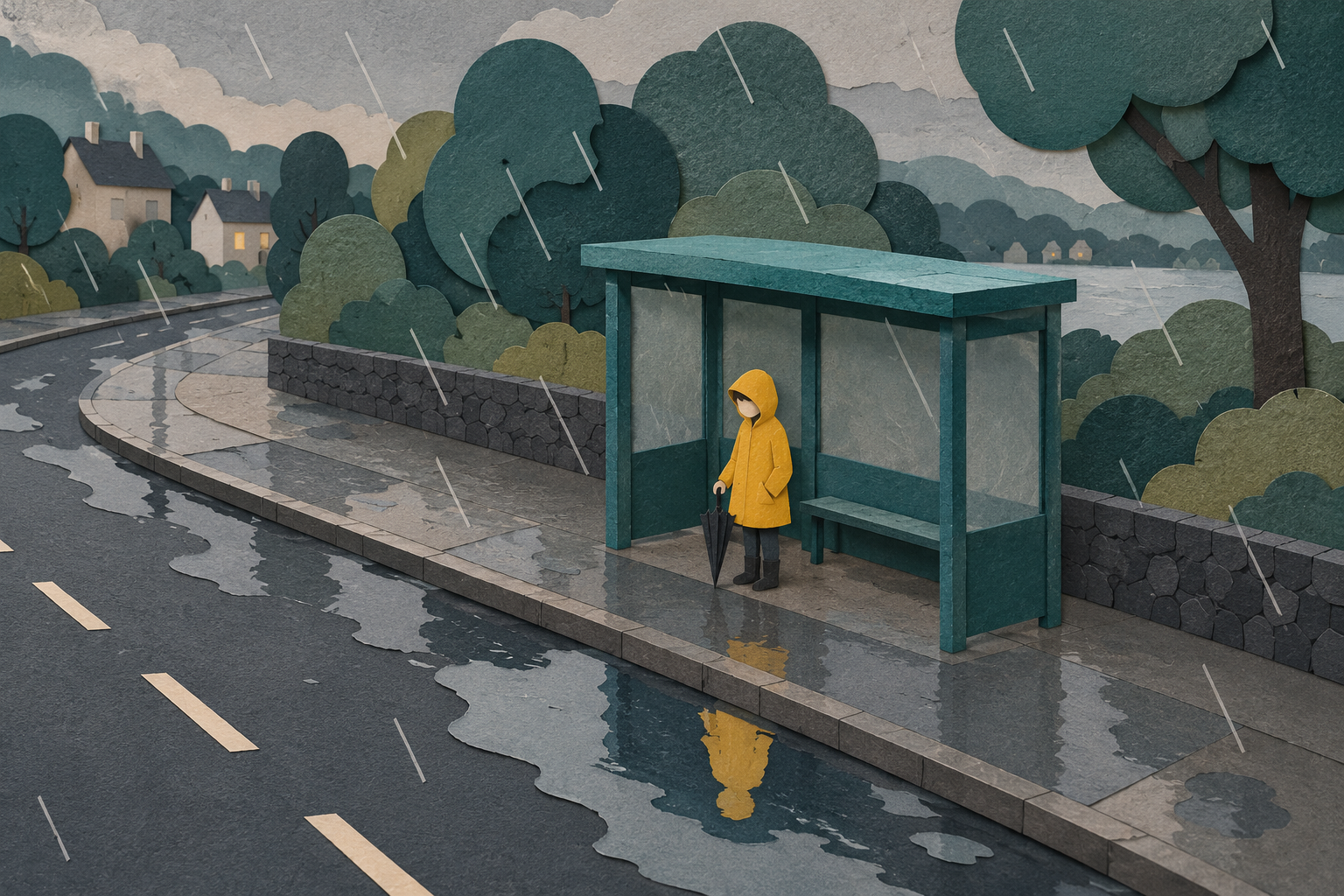
A cut-paper scene needs cut-paper rain. Thin slanted strips, stacked edges and a simplified yellow reflection keep the weather in the same visual language as the shelter and trees. One accent color lets the waiting figure stay small without disappearing.
The image and exact prompt
Original Luxe AI-generated example, created for this issue.
Create a landscape 3:2 handmade cut-paper illustration of a fictional neighborhood bus stop on a rainy afternoon. One small figure wearing an unpatterned mustard-yellow raincoat stands inside a simple teal shelter, holding a closed dark umbrella vertically by their side. Show the whole shelter and figure in a slightly elevated three-quarter view. Build the road, pavement, shelter and distant rounded trees from clearly layered matte paper, with visible cut edges and gentle shadows between layers. Suggest rain with a few thin pale paper strips slanting consistently from upper left to lower right. A broad puddle beside the curb contains a simplified upside-down yellow shape aligned beneath the raincoat; keep it visibly made of paper, not a photographic reflection. Use a muted teal, charcoal, cream and mustard palette. Leave enough quiet space around the shelter to make the yellow coat the first focal point. No bus, other people, words, signage, logos, watermark or photorealistic skin.
What the result did
The layered paper edges, yellow coat and repeated diagonal rain direction read clearly. Two yellow reflected patches appear, one near the figure and one in the road, although the brief requested one simplified reflection. That is the first detail to fix if spatial clarity matters most.
One change to try
Keep the layout and palette. Ask for a single yellow reflected shape in the road puddle and matte, nonreflective paving inside the shelter. Check the reflection's location before adding more texture. This edit remains untested.
A 30-second weather check
- Point to the main subject before you describe the atmosphere. If that is difficult, simplify the background.
- Trace each reflection back to its source. Look for doubled objects, impossible offsets or reflections on a surface meant to be matte.
- Check the weather in the chosen medium: watercolor rings, paper strips or photographic wet highlights should not fight one another.
Your next image: change one weather cue
Pick the scene you would actually like to make. Keep its subject, viewpoint and palette, then change just one cue: the size of the puddle, the number of ripples or the direction of the rain. Save both versions. The useful result is not necessarily the wetter one; it is the one whose story you can read faster.
Source Desk
All three prompts and example images are original Luxe Prompting work created for this issue with an AI image tool. The prompts above are the exact generation instructions. The images are illustrative, not records of real events. Proposed follow-up edits are untested; no model comparison or repeatability claim is made.
Original Luxe example: Let a puddle carry the warm light
Original Luxe example: Make a quiet scene move with three rain rings
Original Luxe example: Translate the weather into the material
A clearer brief. A more useful result.