In partnership with

LUXE PROMPTING
THE TACTILE WORLD WORKSHOP
3 AI Prompts for Tiny Worlds You Can Almost Touch
A convincing miniature needs more than the word detailed. It needs materials with different surfaces, parts that meet, and light that reveals the construction. Try these three original Luxe prompts for a brass workshop, an embroidered railway and a ceramic tide pool, each paired with a fresh AI-generated example.
Master Claude AI (Free Guide)

The professionals pulling ahead aren't working more. They're using Claude.
Our free guide will show you how to:
Configure Claude to be the perfect assistant
Master AI-powered content creation
Transform complex data into actionable strategies
Harness Claude’s full potential
Transform your workflow with AI and stay ahead of the curve with this comprehensive guide to using Claude at work.
The Short Version
- Name the material and how it is made: brushed brass, satin stitches or glaze over carved ripples.
- Specify the joins: boat on cradles, train on bridge, bridge attached at both ends.
- Use light to separate textures, then inspect the frame and fine details before calling the image finished.
Describe construction before decoration
These are AI-generated pictures of imagined handmade objects, not photographs of objects we built. Copy a complete prompt to explore its construction logic. Start with one subject, one material system and one viewpoint. The small imperfections should support that material, not become random noise across the entire image.
1. Put the miniature on a believable support
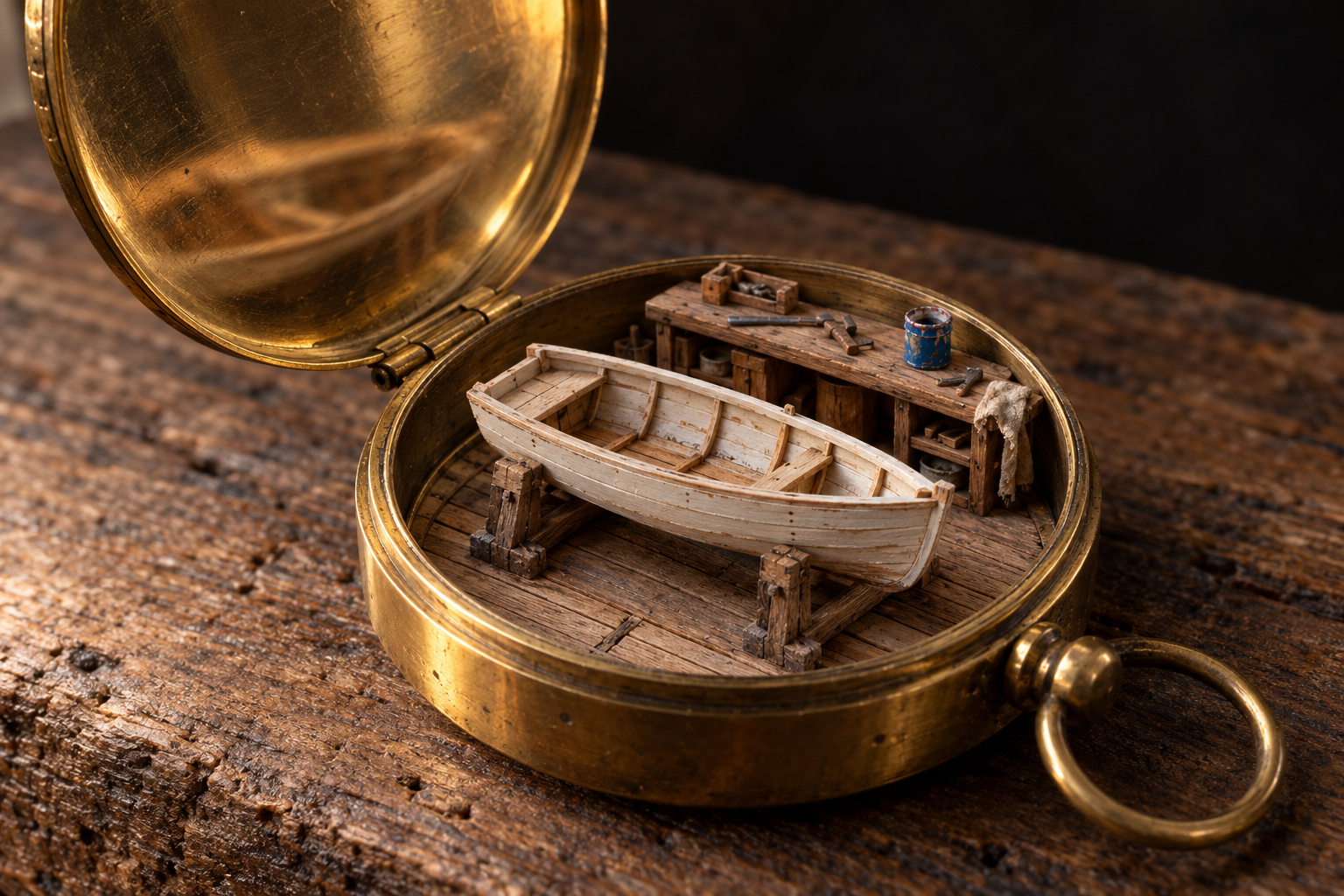
The brass pocket case supplies a strong outer boundary. Inside it, a plank floor supports two cradles, and the cradles support the boat. Naming that chain gives you specific connections to inspect instead of accepting any attractive pile of tiny objects.
The image and exact prompt
Original Luxe AI-generated example, created for this issue.
Create a landscape 3:2 macro studio photograph of an original handmade miniature boat-repair workshop built inside an open brass pocket compass resting on a weathered oak table. The circular compass case and hinged lid remain fully visible and unmistakable. Inside the base, a tiny pale wooden rowboat rests on two timber cradles above a plank floor; a short workbench with one blue paint tin fits behind it. Replace the compass dial with this miniature interior, without numbers or lettering. The open lid reflects a soft, blurred hint of the boat rather than another complete scene. Use a close three-quarter view with modest depth of field so the compass rim, boat and workbench are all legible. Warm side light reveals brushed brass, fine wood grain, tiny tool marks and slightly uneven handmade joints. Preserve believable contact and scale: boat supported by cradles, floor supported by case, nothing floating. A quiet dark background keeps attention on the object. No people, hands, text, logos, watermark or extra boats.
What the result did
The boat rests visibly on its cradles, and brass, wood and paint have distinct surfaces. The upper edge of the open lid is cropped, despite the request to show it fully. With the dial removed, the case is less clearly identifiable as a compass; the image works better as an imagined brass pocket-case workshop.
One change to try
Keep the construction and materials. Request a wider view with clear space above the entire lid. If compass identity is essential, restore a small visible compass needle beside the floor instead of relying on the case alone. Neither revision is demonstrated here.
2. Give each surface a different stitch
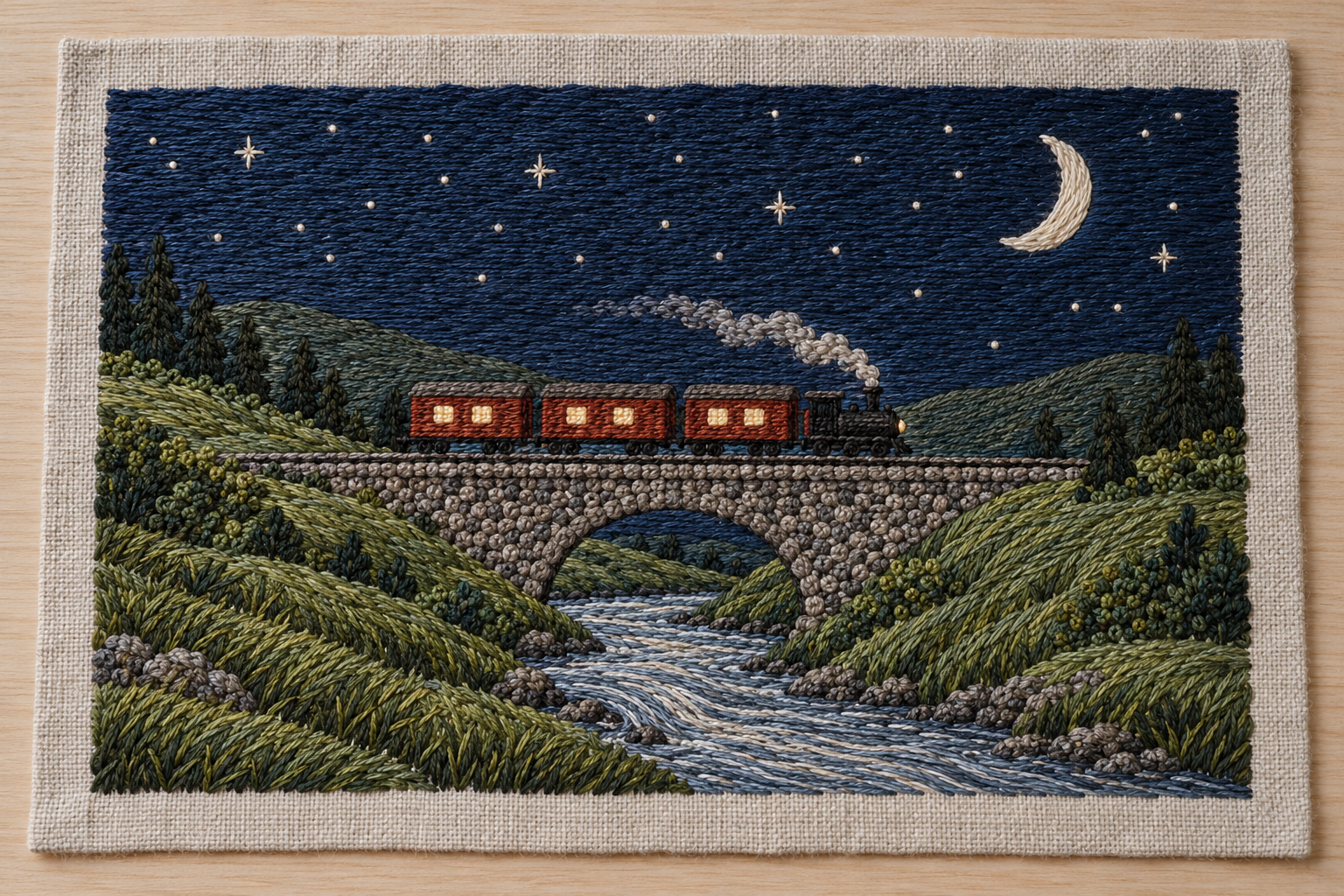
A textile scene becomes more convincing when its sky, hills and stonework are not made from the same texture. This prompt assigns a stitch language to each surface and keeps the artwork flat so the overall composition remains easy to judge.
The image and exact prompt
Original Luxe AI-generated example, created for this issue.
Create a landscape 3:2 photograph of an original embroidered textile artwork depicting a small night train crossing a low stone bridge beneath a crescent moon. The complete rectangular linen artwork lies flat on a pale wooden surface, viewed straight from above with a narrow margin visible on all four sides. Make every part of the landscape recognizably stitched: dense indigo satin stitches for the sky, pale running-stitch stars, moss-green long stitches for hills, textured grey knots for bridge stones, and a rust-red train with exactly three carriages. Each carriage has two softly glowing cream embroidered windows. A thin winding river below the bridge uses parallel silver-blue threads, not shiny plastic. Real thread fibers, slight stitch irregularity and the weave of unstitched linen should remain visible. Soft side lighting reveals shallow thread relief while keeping all corners in focus. Calm and carefully made, with clear train, bridge and river silhouettes. No embroidery hoop, hands, printed graphics, letters, numbers, logos or watermark.
What the result did
All four linen edges are visible. Three carriages each show two cream windows, while the sky, foliage and bridge use noticeably different thread textures. Fine stitches become harder to distinguish in a small email view, so use the overall silhouette first and zoom in to judge material detail.
One change to try
Keep the train, bridge and viewpoint. Reduce the foreground vegetation to fewer larger stitched shapes, then compare how quickly the train reads at phone width. This is a proposed variation, not a finished embroidery pattern or a physical textile.
3. Contrast glaze with unglazed clay
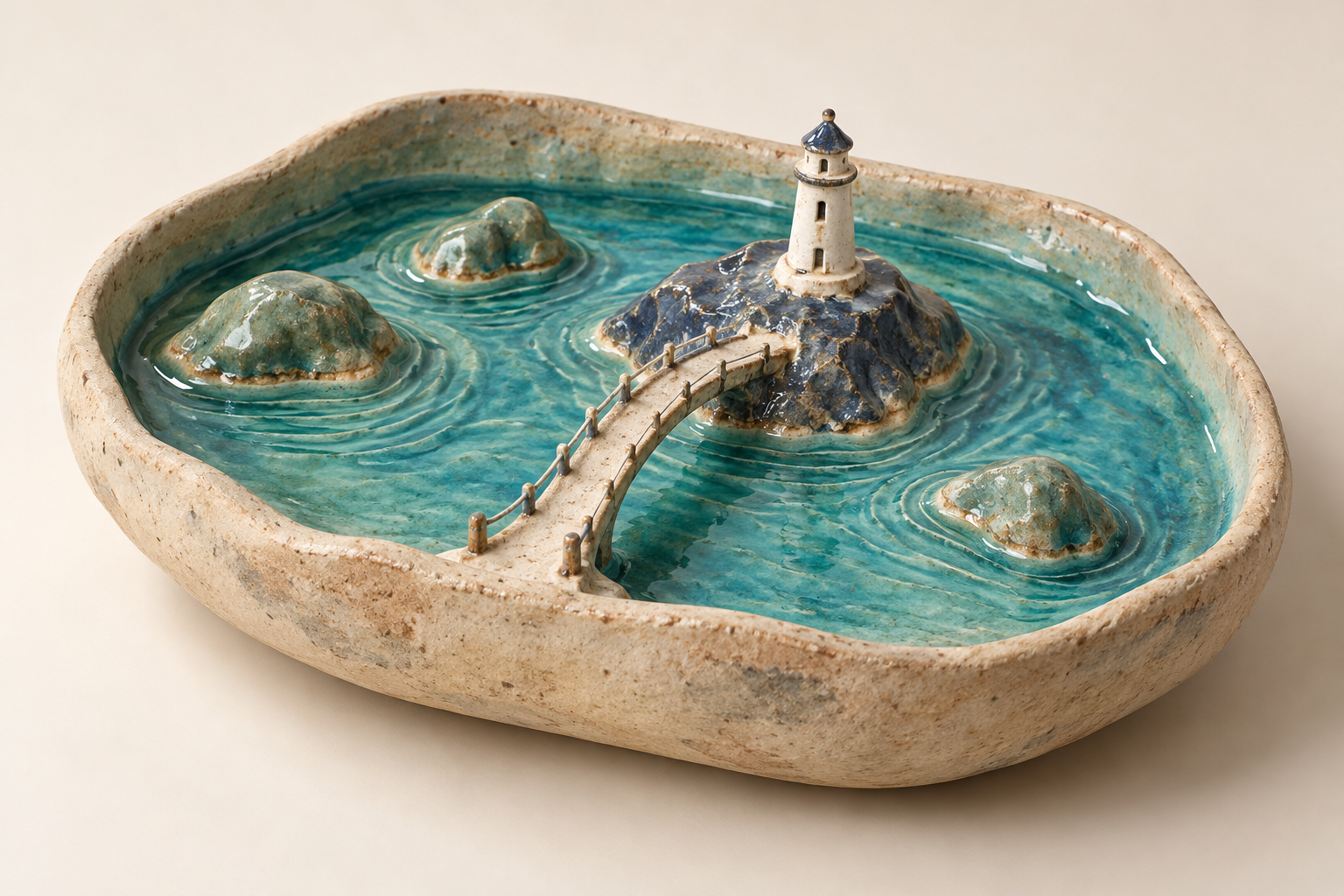
The tide pool uses two kinds of surface on one object: a dry, textured rim and a glossy turquoise interior. A restrained highlight helps suggest glaze; the attached bridge and upright lighthouse make the miniature's layout readable.
The image and exact prompt
Original Luxe AI-generated example, created for this issue.
Create a landscape 3:2 studio photograph of an original hand-built ceramic sculpture shaped like a shallow tide pool inside a smooth irregular oval basin. The sculpture contains one small cream ceramic lighthouse on a dark blue rock island, three low rounded sea-green rock forms and a narrow curved ceramic footbridge connecting the island to the near rim. Water is represented by translucent turquoise glaze over shallow carved ripple lines, not actual liquid. Show the entire sculpture from an elevated three-quarter angle on a warm ivory seamless background, with a soft contact shadow beneath the basin. Use broad diffused light from upper left so the glaze catches a few restrained highlights while matte unglazed clay on the rim stays visibly different. Include slight handmade asymmetry and subtle clay tool marks. Keep the bridge visibly attached at both ends and the lighthouse upright on its island. No people, plants, boats, labels, text, logos, watermark or excessive ornament.
What the result did
The basin is fully in frame, and the bridge visibly meets both the rim and the lighthouse island. The rough cream rim contrasts with the glossy turquoise surface. The interior can still read as actual water at first glance, so the material cue is not unambiguous just because the prompt names glaze.
One change to try
Preserve the silhouette and connections. Ask for shallower, clearly carved ripple grooves with a thinner glaze layer if you want the ceramic construction to read more strongly. This is a visual concept, not a tested fabrication plan.
Inspect it like a maker
- Follow the support chain. Every object should visibly rest on, hang from or attach to something.
- Compare two adjacent materials. If metal, cloth and clay all look equally glossy, narrow the surface instructions.
- Check the entire outline. A beautiful texture cannot recover a cropped lid or a bridge that stops short.
Your next image: choose one join to improve
Before adding another decorative detail, choose the weakest connection in your image. It might be a boat support, a thread edge or the end of a bridge. Keep the rest of the prompt stable and revise that one relationship. Save the first result alongside the revision so you can tell whether the structure improved, not merely whether the texture changed.
Source Desk
All three prompts and example images are original Luxe Prompting work created for this issue with an AI image tool. The exact instructions are preserved above. These are visual concepts of imagined objects, not physical craft projects, fabrication guidance or proof that a named material was used. Proposed follow-up edits are untested.
Original Luxe example: Put the miniature on a believable support
A clearer brief. A more useful result.